





What causes AC refrigerants to leak in Houston homes?
In Houston, the four primary causes for AC refrigerant leaks are corrosion, vibration damage, manufacturing defects, and physical punctures. AC lines are subject to corrosion due to Houston’s coastal salt air and humidity. Disturbances caused by compressor vibration also weaken the integrity of connection points over time. As copper tubing ages and is exposed to the environment, it can develop small pinholes that can cause a refrigerant leak.
AC systems can develop leaks due to physical damage sustained during normal maintenance or contact with animals or weather. By performing regular maintenance, 70% of these leaks can be detected long before a complete system failure in 2026.
Apart from the above mentioned causes, some additional key risk factors increase the refrigerant leak probability among the AC units in Houston, which are listed below:
- Copper tubing corrosion (35% of all refrigerant leaks) is accelerated in Houston’s humid environment.
- Vibration damage to connection points (25% of leaks) is caused over time by the vibration of the compressor.
- Manufacturing defects (20% of leaks) occur within the first five years.
- Physical punctures or damage (15% of leaks) due to improper servicing, impacts, etc.
- Systems that are over ten years old leak three times (3x) more than a newly installed system.
- Improper installation of the unit by incompetent technicians causes approximately 5% of all leaks.
How do I know if my AC refrigerant is low and needs to be recharged?
If your air conditioning system is blowing out warm air, running longer, freezing up, or producing higher than usual energy bills, your unit is most likely to have a low refrigerant problem.
AC refrigerant is the cooling fluid that your AC uses to extract heat; the heavy use from Houston’s hot temperatures makes these leaks more likely to appear than in other regions.
To assist you in identifying low AC refrigerant in your unit some clear warning signs that you should never avoid are mentioned below:
- Not cooling down appropriately.
- Cooling cycles are lasting longer than they should.
- There is ice on the evaporator coils.
- Higher than usual monthly energy bill.
- Hissing or bubbling noises.
- Unevenly cooled rooms.
If you experience one or more of these signs repeatedly, you most likely have a low refrigerant condition. To confirm this and properly recharge your AC, the assistance of a licensed AC technician is required to check the refrigerant levels.
What is the cost to recharge home AC refrigerant professionally?
A professional AC refrigerant costs between $200 and $500, depending on the refrigerant type and unit size. The most common refrigerant, R-410A, will cost between $200 and $350, while R-22, an older refrigerant with limited availability, costs approximately $300 to $500.
In addition to the refrigerant, you have to pay $100 to $150/hour for labor charges, which typically takes 1-2 hours to complete your recharge. If the system leaks, then the cost will be added to your overall recharge cost.
The total cost to recharge a standard residential AC unit in Houston will cost homeowners between $300 and $600 on average. If you need emergency service, you may incur a surcharge of 20% to 50% over your regular rate for same-day or immediate repairs.
A detailed breakdown of the typical AC refrigerant recharge costs, along with the different refrigerant types and additional services, is listed below. It will assist Houston homeowners in making an informed decision:
- R-410A refrigerant recharge, approximately $200 to $350 for a standard residential unit.
- R-22 refrigerant recharge (older system) approximately $300 to 500.
- Labor charges for refrigerant recharging service: $100-$150 per hour, takes more than 1-2 hours.
- Leak detection: $100 to $200 (paid before recharge service).
- Leak repair: $150-$400, depending on the location and severity of the detected leak.
- Complete AC refrigerant recharge service for the average Houston home will cost approximately $300 to $600.
If your air conditioner is low on refrigerant, it won’t be able to keep your place cold enough. You will feel like your air conditioner can’t keep up with the heat, and the temperature of your room will rise a little or more. Whenever air conditioners start failing, people understand that the primary problem lies with the refrigerant.
Air Conditioning Refrigerant is not renewable. It functions during the operational cycle, absorbing heat in the home and transferring it. Think of it as a train on a circular track. In a freely working environment, the air conditioner or heat pump recirculates the refrigerant infinitely. Under normal circumstances, more refrigerant should never be needed, although extreme weather sometimes throws a nasty curveball into the mix.
What are the signs of an air conditioner low on refrigerant?
Unless, of course, your leak is a large one, with an audible hiss, diagnosing and fixing refrigerant leaks will usually take more than one visit. Sometimes professionals need to add dye to trace a pinhole; they are often hard to locate. Extremely high temperatures can pop open welded piping joints and give you a leak. Most likely, this kind of scenario will be experienced with an indoor evaporator because that’s the area that goes through the most extreme temperature fluctuations.
As a homeowner, it can get tricky figuring out what has gone wrong with your unit until it completely shuts down. However, if you keep track of the indoor temperature and humidity rising a little at a time, then, in some cases, you may be able to catch it early enough to avoid more costly repairs.
Here are the Low refrigerant signs-
- Your AC takes longer than ever to cool off:
The longer and longer your home starts taking to cool off, the more likely you are to have a problem with refrigerant. For example, your indoor thermostat might just slowly be climbing up in temperature and humidity levels with no logical reason for it. Another classic symptom is that your air conditioner doesn’t cool well during the day but makes up for it in the evening.
- Indoor Air Not Blowing Cool Enough:
What is the temperature like when you put your hand in front of the vents blowing conditioned air? A temperature that feels too warm may sometimes indicate a refrigerant problem. Do not forget that it may not blow as cool at an outside temperature of 100 degrees.
- Ice on Copper Lines:
When there is an imbalance in refrigerant levels, the refrigerant may become extremely cold and impede airflow. Limited airflow then places heavy demands on the air conditioning system, potentially resulting in the freezing and failure of the system’s evaporator coil. Then again, dirty filters could lead to reduced airflow, which is another reason for the indoor coil to freeze.
- Water Pooling around the Furnace:
When your air conditioner has been frozen up for a long time, it will eventually thaw out, and condensation will begin dripping from it. We check for evidence of pooling water around the indoor furnace since that can sometimes indicate a refrigerant problem.
- Listen for a bubbling noise or hissing:
Somewhere, someway, if you have a really bad leak, you might hear a hissing or bubbling sound coming from the evaporator coil inside your house or from the condensing unit outside. The temperature inside your house just might rise rapidly and become very uncomfortable.
Now and then, we run across air conditioning units that have lost all their refrigerant due to what we call blown points—another term for compressor failure. If the compressor fails due to some electrical failure, the refrigerant supply is lost in one go out of the window with the outdoor unit blowing oil and residual refrigerant along the bottom of the outdoor condenser. If the conditions are right, you’ll hear a loud hissing noise and perhaps see a whitish cloud. Very dangerous to be around, so stay away. We suggest getting a technician on-site to evaluate the situation.
- Short Cycling:
An air conditioning system that attempts to cool but cannot enter a potentially vexatious repetitive sequence of operations is referred to as “short cycling.” Short cycle-on-and-off refers to an air conditioner that switches on and runs shortly, then switches off again. In other words, it never even gets fully through a true cooling cycle. If this occurs, there will now usually be an increase in the humidity levels inside the home.
During initial startup, an air conditioner’s cooling effect removes a ton of humidity, immediately making the house feel much cooler. Conversely, an air conditioner that cycles on and off won’t sufficiently remove humidity so that people can feel comfortable.
- Electric Bills Higher:
Very high electric bills are one good clue that refrigerant may be a problem. Electric bills, during particularly hot summer weather, will usually be high. This does not automatically indicate refrigerant problems. That said, the ailing unit that is barely able to cool because of a lack of refrigerant to work at all usually has high utility bills, unlike the ones that run smoothly. If the refrigerant level is below the required level for cooling the home, the air conditioner’s compressor will keep running for long hours, undoubtedly way beyond normal operation.
ProTip: Look at your price per kilowatt-hour on your bill because sometimes, during certain market conditions, the price of electricity could change behind the scenes in Texas.
Is Low Refrigerant an Emergency or Can It Wait?
Low refrigerant is not a normal maintenance issue and should never be ignored. Use this quick guide to decide your next step.
You should call a professional AC technician immediately if ANY of the following apply:
- Your AC is blowing warm or barely cool air
- Ice is forming on refrigerant (copper) lines or the indoor coil
- You hear hissing or bubbling sounds
- Your system is short cycling or struggling to stay on
- Indoor humidity is rising and comfort is rapidly decreasing
If yes to one or more:
Your system likely has a refrigerant leak. Continuing to run the AC may cause compressor damage, leading to far more expensive repairs.
You should not attempt DIY fixes if:
- Refrigerant levels are suspected to be low
- The system has frozen or shut down
- You are unsure where the leak is coming from
In these cases:
Professional diagnosis is required to locate the leak, repair it safely, and recharge the system to manufacturer specifications.
Still unsure?
A professional inspection can confirm whether the issue is refrigerant-related or another airflow or mechanical problem.
Because refrigerant issues can quickly lead to major system damage, Texas Strong Mechanical is currently offering $50 OFF on any AC repair performed by certified technicians.
If you suspect low refrigerant or notice any of the symptoms above, it’s best to schedule a professional inspection as soon as possible.
Call (832) 419-4488 to book your visit today.
What is the main cause behind this refrigerant leak?
Refrigerant leaks are more common in older air conditioning units and heat pumps than in newer equipment. Standard wear and tear and corrosion take their toll on air conditioners, which is why, normally, air conditioning equipment lasts, statistically, for about ten to fifteen years. If you do your best in maintaining an air conditioning system, chances are you could extend its life further.
Other common reasons for the cause of refrigerant leaks-
- Defective rubber seals around the air conditioning service valve
- Loose assembly joints for the outer unit
- The absence of service caps replaced post-servicing.
- Corrosion of copper lines: Formicary corrosion is the prescribed technical term that describes corrosion and pinhole leaks caused upon exposure of the materials to an environment contaminated with formaldehyde and formic acid. Both contaminants are present in the building materials and have low levels in most indoor air.
- Inadvertent puncture for the refrigerant line: Remodeling and lawn care are the normal reasons for such accidental damage.
- Vibration due to improper installation of HVAC unit: If the system is not well anchored and properly installed, the vigorous action of the motors can further loosen or break joints and cause leakages.
How can Low Refrigerant be diagnosed?
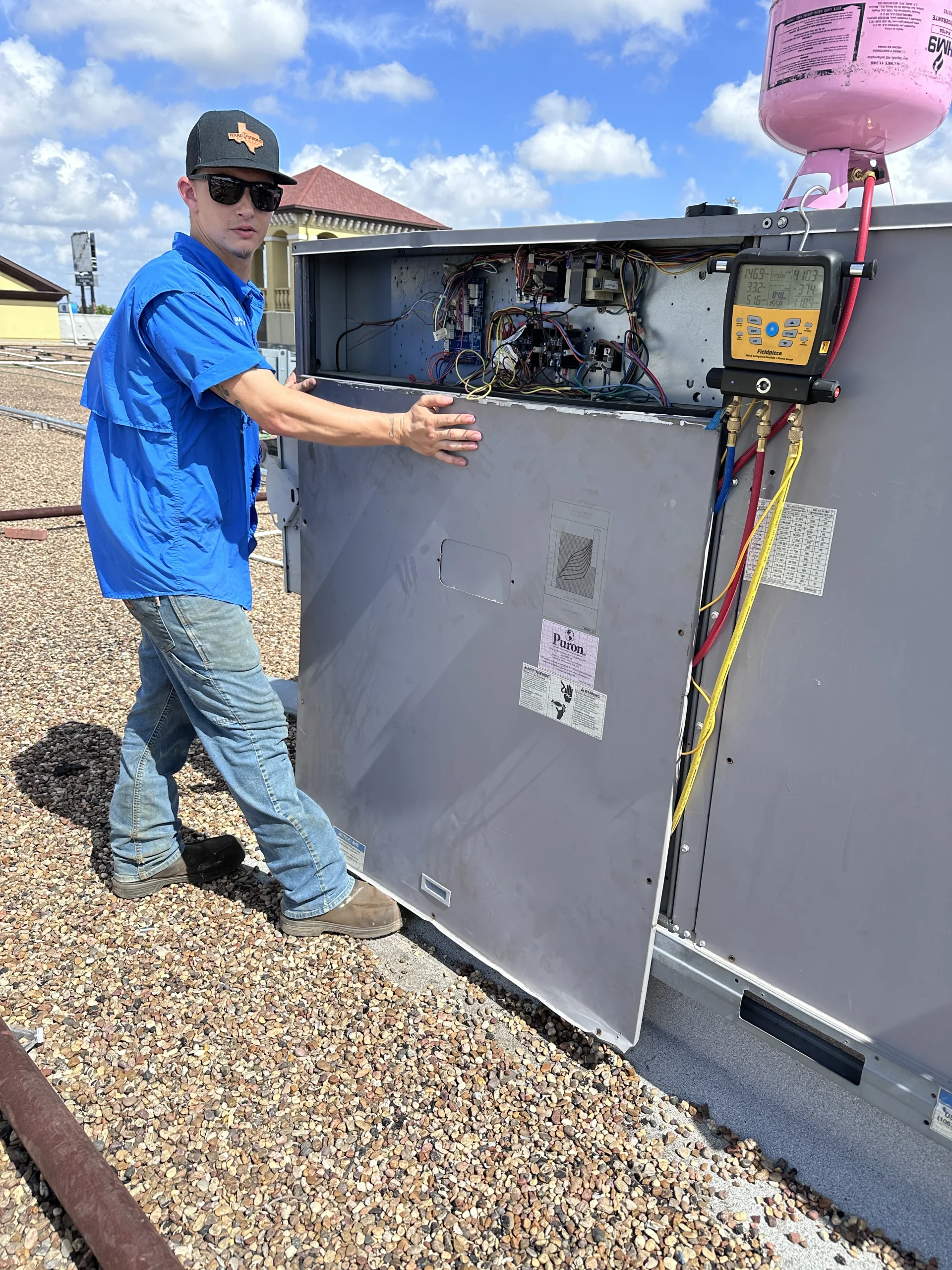
The air conditioning technician will inquire about the operation of your air conditioner with some questions; the more you can share, the easier the diagnosis will be. An HVAC technician brings with him gauges that can give some pointers through the observations of pressure, which is inside your air conditioner. Specialized gauges are set up on the outdoor condensing unit to evaluate the pressures and refrigerant charging of the condensing unit. If the technician cannot hear a hiss indicating a leak, a dye will be injected into the system. This will help a lot in pinpointing very small leaks. After the HVAC technician evacuates the system, meaning that they will take all the refrigerant safely from the system so that it cannot exit into the air.
Next, they will repair the leak. Then they will test for the repair. After this, they will put refrigerant back into your air conditioner in the correct amount as per factory specifications. Also read Difference between AC repair and AC replacement
This type of repair is better left to the professionals. The refrigerants currently being used are regulated under the EPA and classified as ozone-depleting substances. There are special requirements in place for working personnel with refrigerants for safety and the protection of the environment. Thus, it is never permissible to let refrigerant vent into the atmosphere.
Is it possible that my low refrigerant could damaged my air conditioner?
Problems would exist for all the individuals indoors if there is a low refrigerant in the place. It may also have repercussions that would flow into your bigger system. This compressor may also have been subjected to continuous exposure to low refrigerant operation, which would then have earlier wear-out of its parts than what is prescribed. In the worst-case scenario, it would also damage the compressor, which acts like an engine driving the refrigeration process. While compressing that air, the compressor motor may be damaged due to heavy work done to compress air. The evaporator coil will freeze completely because of being out of balance on refrigerant. Government rules and regulations require refrigerant leak repairs, as certain refrigerants leaking into the air have environmental or health impacts. This is why if there is a leak, it must be repaired. Also read How Often Should Air Conditioning Units Be Serviced?
Thus, another reason you may want to repair it right away is that 1. refrigerants are costly, and 2. only balanced refrigerant levels can result in a comfortable temperature indoors.
Conclusion
Anyone who has tried to stay cool on a hot day knows that refrigerant leaks can be a nasty thing to deal with. If you are facing a problem with this kind of problem, professionals will make a diagnosis so that your air conditioner or heat pump is soon back in service. For those curious, we think refrigerants and air conditioners are good subjects to learn about. We believe homeowners should be well informed about their HVAC investment so that they have the information needed to keep their air conditioning systems running now and well into the future. Also read How to Identify and Deal with HVAC Emergencies?
